
Running a Sex Offender Check in Hardin County
The official public route is the Illinois State Police Sex Offender Registry. It covers Illinois registrants and states that its database is updated daily. A Hardin County search can begin with a known first and last name, then use date of birth, city, ZIP code, county, status, homeless status, or offender type to narrow a result. The separate geographic tool can help a reader understand registrations near a chosen address or map point.
The registry is the best first stop for current public registration data, but it is not a full Hardin County criminal-history search. A listing concerns a statutory registration duty. Court pleadings and dispositions remain with the Circuit Clerk, while an incident report belongs with the agency that handled the event. ISP also cautions that a listing does not predict future behavior and that some information supplied by a registrant can be inaccurate. Match several identifiers before drawing a conclusion.
The Hardin County Registry Disclaimer Gate
Every official Hardin County registry lookup begins at the ISP conditions-of-use screen. The Illinois State Police registry disclaimer explains the limits of the data and requires acceptance before the live search opens. This step matters because it places accuracy, lawful use, and personal conduct ahead of the result list.
The official disclaimer screen used for a Hardin County check is shown below without any private registrant information.
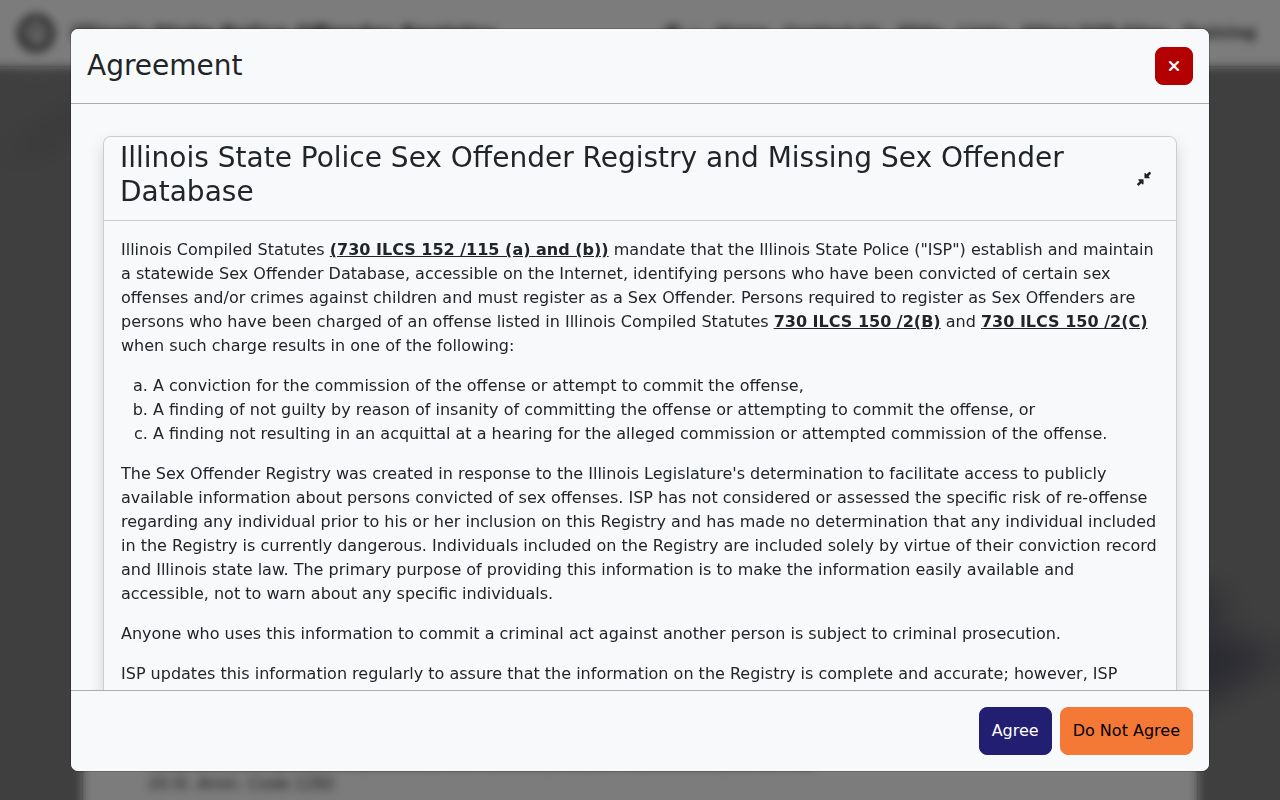
After accepting those terms, use the official state search rather than an unofficial copied list.
Searching the Illinois Sex Offender Registry
The Illinois Sex Offender Registry search provides both identity and place-based controls. None of the listed fields is described as universally required, so a broad query can be narrowed when the first result set is too large. ISP recommends starting with first and last name. For a common name, adding date of birth or Hardin County location details reduces the risk of confusing different people.
- Open the ISP disclaimer, read the conditions and limits, and accept them to enter the public search.
- Enter first and last name when known, or begin with city, ZIP code, county, or another available filter.
- Compare multiple identifiers in the result list instead of relying on a name or photograph alone.
- Select “Details” for the appropriate result and read its offense, agency, address, classification, and compliance information.
The official search interface pictured below is the source for these fields and controls.
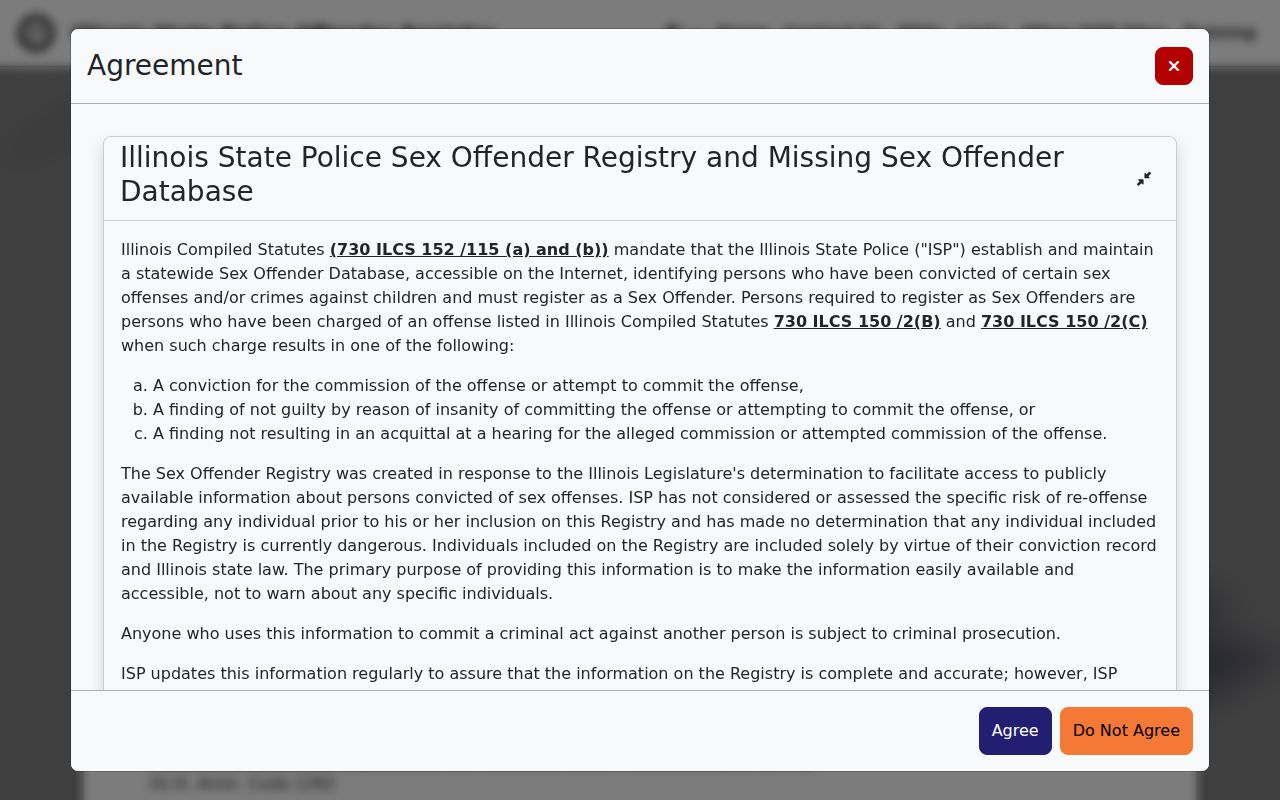
The field set supports a focused Hardin County registry search without requiring a private profile to be reproduced here.
| Field label | Type | Required | Search note |
|---|---|---|---|
| First Name | Text | Optional | ISP recommends starting with first and last name. |
| Last Name | Text | Optional | Combine with another identifier for common names. |
| Date Of Birth | Text/date | Optional | The accessible page did not state an exact format. |
| City | Text | Optional | Enter an Illinois municipality. |
| Zip Code | Text | Optional | Uses a five-digit ZIP code. |
| County, Incarcerated or Out of State | Dropdown | Optional | Select Hardin County or a listed custody/location category. |
| Status | Dropdown | Optional | Narrows by a compliance-related status. |
| Homeless | Checkbox | Optional | Narrows results to homeless registrants. |
| Offender Type | Dropdown | Optional | Filters registry classifications. |
| Map Your Neighborhood | Address/map point | Optional | Yellow map markers open details in a side pane. |
Hardin County Name Search or Neighborhood Map
The two search styles answer different questions. A name search is stronger when checking a specific identity because it can combine name and date of birth. “Map Your Neighborhood” starts with an address or selected map point and is better suited to local awareness when a person’s name is not known. Yellow markers open more information in the tool’s right pane.
Map position should not be treated as a precise statement about property boundaries or a person’s location at every moment. The accessible ISP material did not expose exact radius choices, so no distance should be assumed. For either method, open the detail view and check the registering agency and current status. The Hardin County filter can also help separate local records from incarcerated or out-of-state categories.
What a Registry Profile Shows
An ISP details page organizes public identity, registration, offense, and compliance categories. Because the research did not preserve a private registrant’s profile, the inventory below describes confirmed category-level content, not one person’s record. Vehicle, employer, and school details are not promised because those fields could not be verified through an anonymized live profile.
| Name & Aliases | Reported name and aliases used to distinguish the listed person. |
|---|---|
| Photo & Physical Description | A photograph when available, physical descriptors, age or birth information, and distinguishing marks. |
| Registered Address | The last reported address or location status shown in the public record. |
| Offense & Conviction | Public offense and conviction information associated with the registration duty. |
| Classification | The offender classification that helps explain duration and verification duties. |
| Registration Status | Registering agency plus compliance or location-unknown information when applicable. |
A profile is not the underlying Hardin County court file. Readers who need filed charges, motions, disposition, or sentence should verify those items through the Hardin County criminal court case record rather than infer them from registry shorthand.
Who Handles Hardin County Registration
Jurisdiction turns on where the registrant resides. Illinois guidance says a person inside a municipality registers with the city police agency that has jurisdiction. A person in an unincorporated part of Hardin County registers with the Hardin County Sheriff. This boundary matters in a county that includes Rosiclare, Cave-in-Rock, and Elizabethtown as well as rural areas.
No official municipal department contact pages were located during the research. Before traveling, call the Hardin County Sheriff at (618) 287-2271 to confirm which agency accepts the registration, where to go, current hours, and whether an appointment is needed. The sheriff is listed at 1 Courthouse Hill, P.O. Box 246, Elizabethtown, Illinois 62931. Accuracy questions about a public entry should go to the registering agency; court-paper questions belong with the Circuit Clerk or State’s Attorney.
Registration Requirements and Levels in Illinois
Illinois uses classifications and circumstances that affect both the length of registration and how often a person reports in person. The ISP registration FAQ is the official source for the broad periods below. It also says the initial registration fee is $100 and the annual fee is $100, subject to law. Noncompliance, later offenses, and time in custody can extend or toll the period, so a simple calendar estimate may be wrong.
The official FAQ interface below is useful when a Hardin County profile raises a question about duration, frequency, moves, or fees.
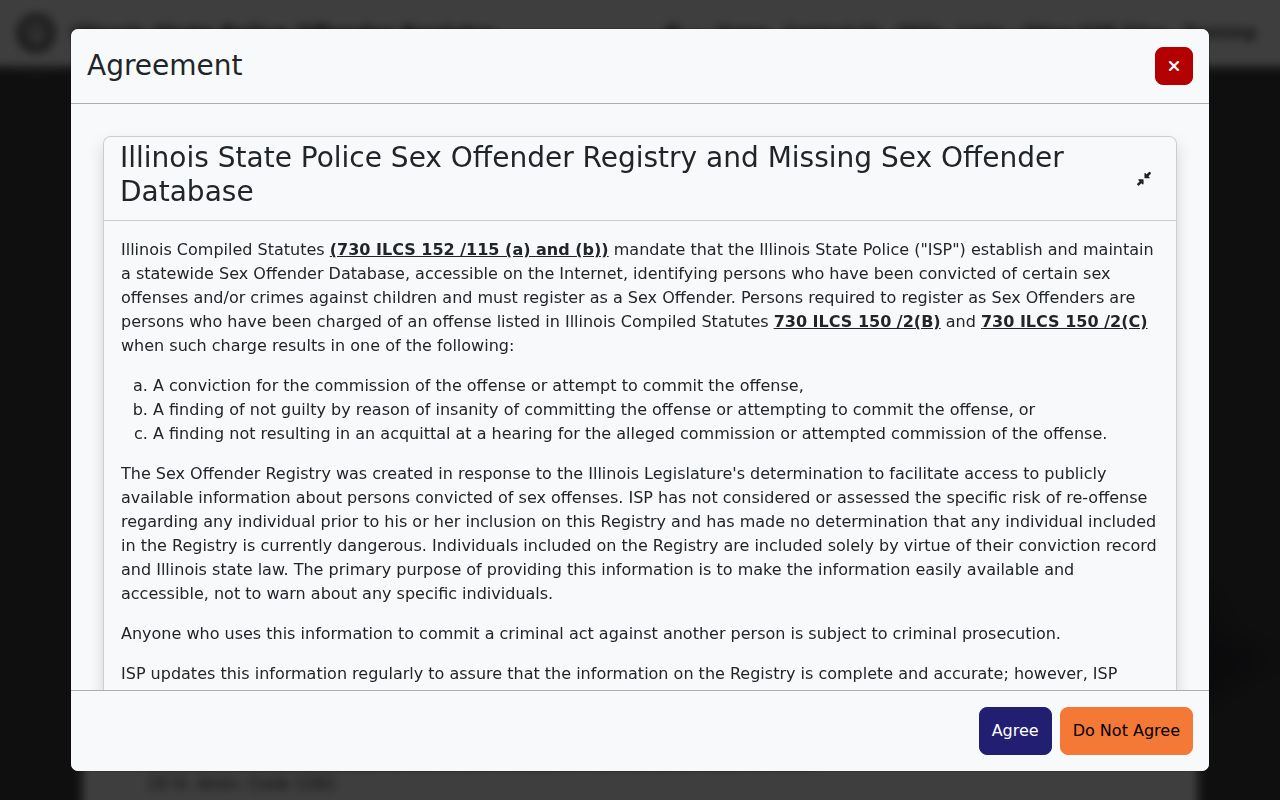
Classification and verification frequency should be read together rather than treated as interchangeable labels.
| Classification or circumstance | Duration | Verification frequency or deadline | Public visibility |
|---|---|---|---|
| Sex offender | Generally 10 years | Annual in-person registration | Public registry categories apply while registered. |
| Sexual predator | Natural life | Annual registration | Public registry categories apply. |
| Sexually Dangerous or Sexually Violent | Natural life | Every 90 days | Public registry categories apply. |
| SORA violation conviction on or after July 1, 2005 | For the registration duration | Every 90 days | Status may appear in public registry information. |
| Move or information change | Existing period continues | Report within 3 days | Updated public fields depend on the reported change. |
| Visitor exceeding the threshold | As required by the visit rule | Register after accumulating more than 3 days in a calendar year | Local registration information may become public. |
Hardin County Registry Status Is Not Conviction
Terms such as non-compliant or location unknown describe registration status. They do not, by themselves, prove that a new criminal conviction has occurred. Likewise, a public profile does not replace a complete Illinois criminal-history record. ISP warns that registrant-supplied data may be inaccurate and that the registry is not a prediction of future conduct.
If a Hardin County entry appears wrong, note the exact field and the registering agency shown on the profile. Direct the accuracy question to that agency. Ask the Circuit Clerk or State’s Attorney about court documents, and ask the involved law-enforcement agency about an incident report. Keeping those channels separate avoids asking the registry to supply records it does not maintain.
Hardin County Cross-State Registry Search
Hardin County sits along the Ohio River, so a place-based safety question may cross an Illinois state line. The U.S. Department of Justice National Sex Offender Public Website provides a national search layer that draws from participating jurisdictions. It is the appropriate next step when an address, trip, or known person cannot be checked within Illinois alone.
The official NSOPW search screen below shows the national entry point without reproducing a registrant’s identity.
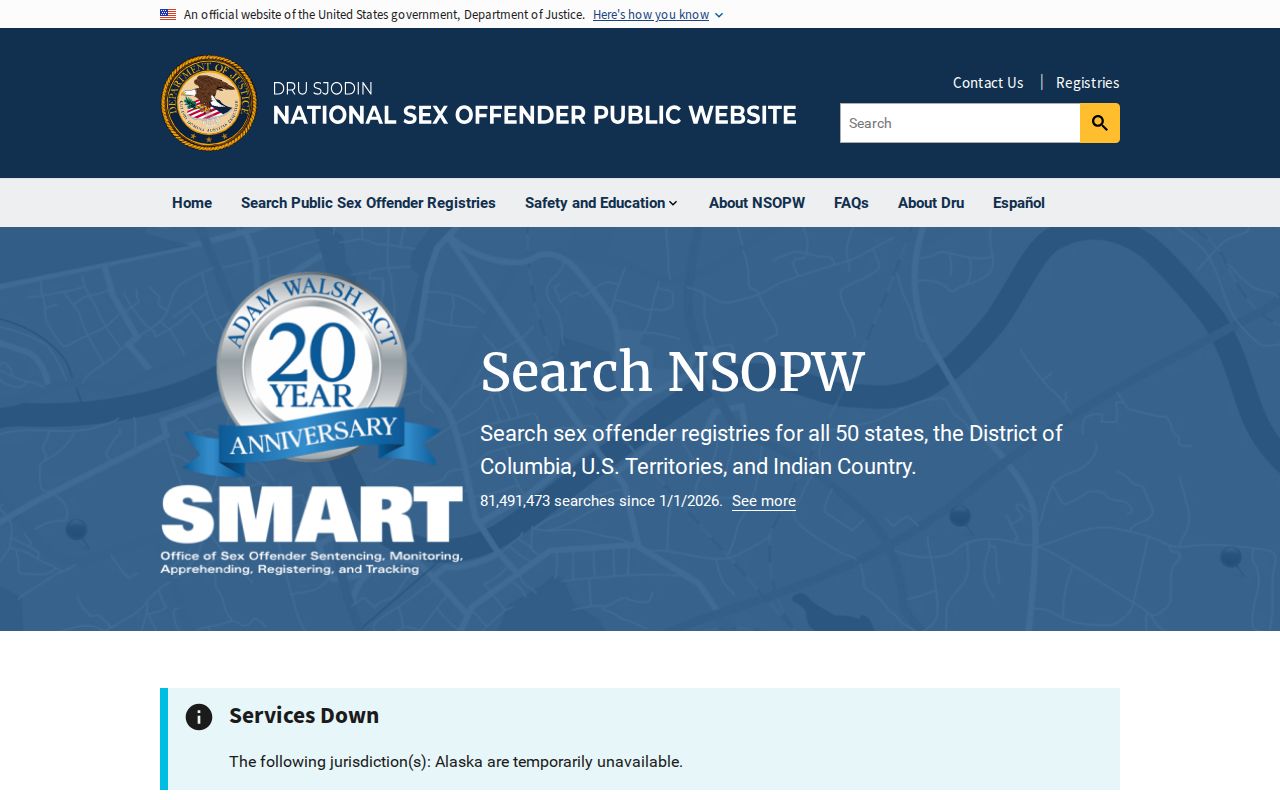
When a national result points back to Illinois or Hardin County, use the ISP profile and registering agency as the sources for Illinois-specific details and correction questions.
Lawful Use and Community Notification
The registry exists to support public awareness and safety planning. Illinois governs registration through the Sex Offender Registration Act, 730 ILCS 150, and the Sex Offender Community Notification Law, 730 ILCS 152. Those laws and the ISP registry process allow public access while also setting limits. A listing should be verified, used with care, and never turned into a reason for vigilantism.
Misuse can be criminal: ISP warns that harassment, stalking, threats, or intimidation based on registry information may violate criminal law. The governing registry and notification statutes are 730 ILCS 150 and 730 ILCS 152.
Community notice does not make every related government record part of the registry. The registering agency maintains registration information, the courts hold filed cases, and law-enforcement agencies hold their own reports. That division is especially important when a result raises an accuracy question or when a reader needs the source document behind an offense description.